The Jiufen + Shifen day, start to finish
Two very different Taiwans, an hour apart
Jiufen and Shifen aren't the same kind of place, which is exactly why they're usually paired. Jiufen is a gold-mining town clinging to a mountainside above the coast, built on Qing-dynasty gold deposits and boomed again under Japanese colonial rule; when the mines closed in 1971 it emptied out almost completely, only to be rediscovered after Hou Hsiao-hsien's 1989 film A City of Sadness — partly shot on its stairways — won the Golden Lion at Venice and sent Taiwanese tourists back up the hill. Shifen is a different story: a strip of houses and teahouses squeezed onto a narrow ledge along the Pingxi branch railway, where the sky-lantern tradition began generations ago as a way for villagers hiding from bandits in the hills to signal home that it was safe to come down.
What a single day actually covers
Door to door from central Taipei, figure on roughly seven hours whether you're guided or doing it yourself: about 45 minutes each way to Jiufen by road, and a further stretch into the Pingxi valley for Shifen, either by branch-line train from Ruifang or by the mountain road most tour vans take directly. That's enough time to properly walk both old streets, release a lantern and see the waterfall, without the trip turning into a transit day.
Why the running order matters
Nearly every tour that does both sites — including the one we feature below — visits Shifen first, in daylight, and saves Jiufen for last. There's a practical reason: the waterfall and the lantern release both photograph and simply feel better in daylight or at golden hour, while Jiufen's whole appeal is the lantern glow against the dark, so arriving as dusk falls is when the town looks like the photos. Doing it the other way round — Jiufen by day, Shifen at night — leaves you fighting crowds in flat afternoon light at the one place and standing in the dark at a working railway stop for the other.
The day at a glance
- Typical lengthAround 7 hours door to door, including travel time from central Taipei
- Usual departureEarly-to-mid afternoon, so Shifen comes first and Jiufen is seen after dark
- What's coveredReturn transport, a guide, and time at both the waterfall and the old streets
- When it runsMost days year-round — the lantern release only pauses in genuinely severe weather
After dark in the mountains
Jiufen Old Street after dark
The stairway everyone photographs
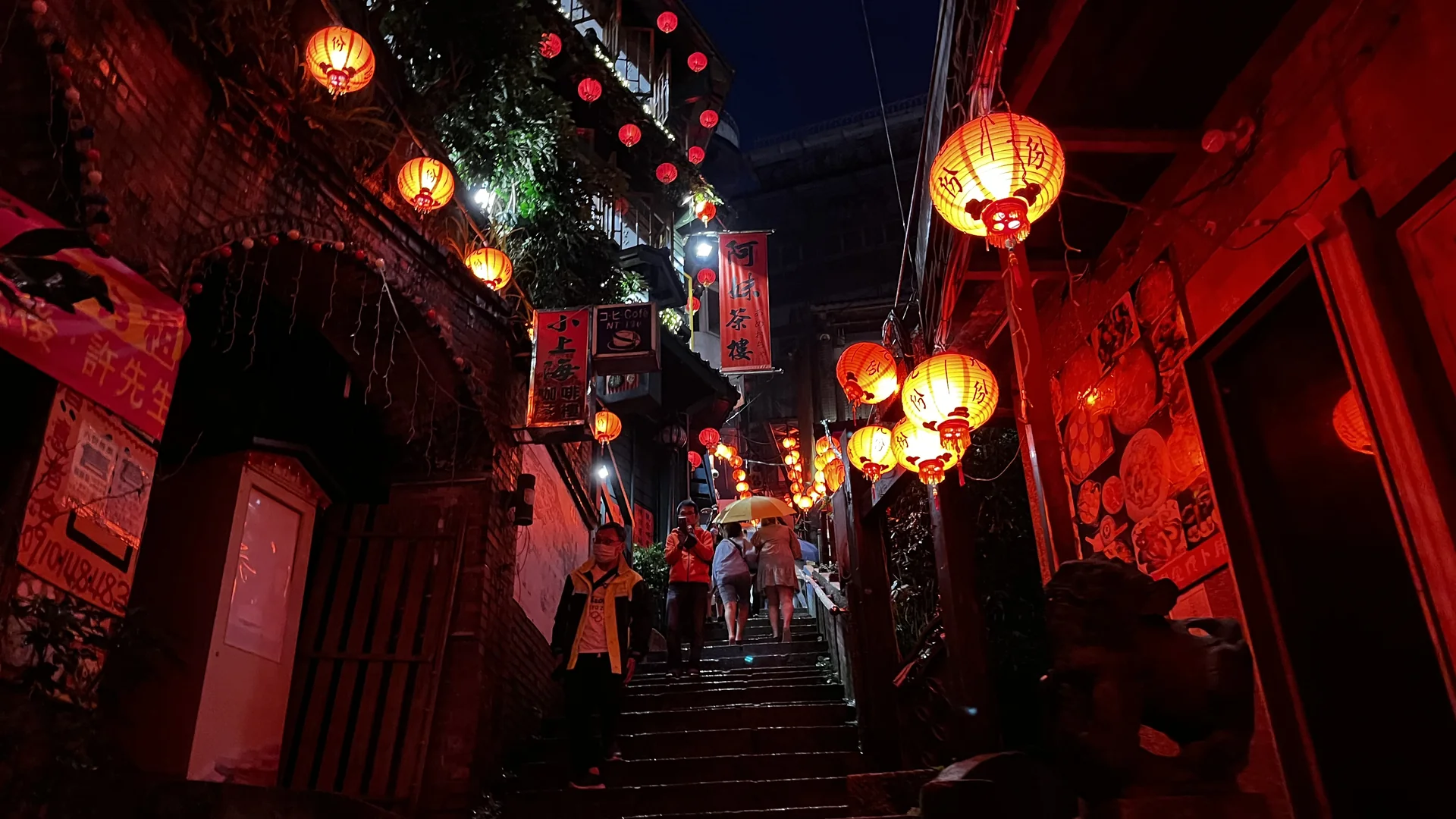
Shuqi Road — the steep, narrow stone stairway lined with red lanterns and stacked teahouses — is the image most people have of Jiufen before they've ever been, and in person it's narrower and steeper than it looks in photos. Public electric light barely reaches most of it; the lanterns strung overhead are doing the actual work of lighting the stairs, which is why the town waits for dusk rather than switching them on at some fixed hour. Expect to queue for the best photo spots on the stairway itself on a Saturday night — it's a single-file street on a hillside, and everyone visiting wants the same shot.
The Spirited Away question
It comes up on almost every visit: does Jiufen's lantern-lit, multi-level old town look like the bathhouse world of Hayao Miyazaki's Spirited Away? Visually, yes, close enough that the comparison follows the town everywhere — but Studio Ghibli and Miyazaki himself have said the film wasn't directly based on it. What Jiufen and the film share is a real historical type: dense, vertical Taiwanese mining-town architecture, the kind of place that looks partly imagined even when it isn't. Go for the atmosphere on its own terms and the resemblance is a bonus, not the reason to visit.
The teahouses, and what to actually expect
Jiufen's teahouses — A-Mei Tea House, perched over the stairway, is the best-known — serve loose-leaf Taiwanese tea in multi-cup sets with a small charcoal or electric warmer, usually with a modest snack menu rather than a full meal. Seating with a view over the coast and Keelung Mountain gets scarce after 6pm; if a window table matters to you, arrive with the early dusk crowd rather than after full dark. It's a sit-down, slow-down stop, not a quick coffee — budget at least half an hour if you want a table at all.
Down in the Pingxi valley
Shifen: sky lanterns & the waterfall
Writing a wish, then letting it go
At the stalls along Shifen Old Street you buy a paper lantern — the colour is meant to correspond to a category of wish (pink for love, yellow for wealth, and so on, though nobody enforces it) — brush your wish on each of its four panels in ink, then light the base and release it by hand. The lanterns rise directly over the train tracks that run through the middle of the street, which is the entire point of the ritual and also why staff will pull everyone back onto the platform edges the moment a train's due.
Where the tradition actually comes from
The sky lantern isn't a manufactured tourist experience bolted onto a scenic spot — it has a real, older function. In the Qing era, villagers who'd fled into the hills around Shifen during bandit raids used lanterns released from the peaks to signal down to Pingxi that it was safe to return home. That signalling tradition became the Pingxi Sky Lantern Festival, still held around Lunar New Year, and the everyday version — a single lantern, any day of the year — grew out of the same custom rather than being invented for visitors.
The waterfall itself
A ten-to-fifteen-minute walk from the old street, Shifen Waterfall is around 40 metres wide and 20 metres high, curtain-shaped rather than a narrow drop, which is why it's long been nicknamed "Taiwan's little Niagara" locally — a comparison about shape, not scale, since it's a fraction of Niagara's size. It's the widest waterfall in Taiwan and sits inside a public park with a viewing platform and a suspension bridge, an easy add-on to the lantern release rather than a separate trip.
More ways to see Jiufen & Shifen
Find a Jiufen & Shifen day tour for your dates
Every option below is bookable through GetYourGuide, with live availability and the final price shown in your own currency before you pay.
Getting there
How to do it: guided tour vs train-and-bus
Both sites are reachable without a tour — the question is whether the time and hassle saved is worth the fixed schedule. Here's the honest version of each.
Simplest, fixed schedule
A guided day tour
A guide meets you in central Taipei, handles the drive to Shifen and Jiufen directly (skipping the Pingxi branch line's limited timetable), stays with the group at both stops, and times the day so Jiufen falls after dusk. You give up choosing your own pace and departure time in exchange for not having to plan train connections or find your own way back after dark.
Cheaper, more flexible, more homework
Train and bus, self-guided
From Taipei Main Station, take the Taiwan Railway to Ruifang (around 40 minutes), then either the Pingxi branch line to Shifen — roughly one train an hour, so the schedule dictates your day — or a direct bus from Ruifang or Taipei to Jiufen. There's no rail link to Jiufen itself; getting between Jiufen and Shifen means a bus back through Ruifang. It costs a fraction of a tour and lets you linger, but only if you're comfortable reading a Taiwanese rail timetable and don't mind the connections not always lining up.
Timing it right
Best time of day & year to go
What time of day, and why it's not just about crowds
Arrive in Shifen while there's still good light for the lantern release and the waterfall, then time Jiufen for the window right at dusk — not full darkness, when the lanterns are lit but there's still enough ambient light to see the layout of the stairways and the sea beyond them. That's a narrow window, roughly the hour spanning sunset, which is exactly why most tours are built around reaching Jiufen right as it starts.
Weekday versus weekend
Shuqi Road on a Saturday evening is genuinely crowded — a slow, shuffling queue rather than a stroll — while a weekday visit, even at the same dusk hour, is a noticeably different experience with room to actually stop and look. Shifen's old street is narrower still and shares its width with a working railway, so weekday visits are the easier choice there too if your schedule allows it.
Season and weather
The Lunar New Year period (dates shift, typically late January to mid-February) brings the Pingxi Sky Lantern Festival proper — spectacular, but Shifen and the surrounding valley get considerably busier than an ordinary day trip, and lantern colours can sell out. Typhoon season, roughly July to September, occasionally cancels the lantern release outright on the worst days; the hills around both towns are also simply rainy and misty for a good part of the year, which suits Jiufen's atmosphere more than it hurts it — bring a layer and expect the stone stairways to be damp underfoot.
GEO/FAQ
Jiufen & Shifen questions
Can I visit Jiufen and Shifen in one day without a tour?
Yes. Take the Taiwan Railway from Taipei Main Station to Ruifang (about 40 minutes), then either the Pingxi branch line on to Shifen (roughly one train an hour) or a direct bus to Jiufen. There's no rail line between Jiufen and Shifen themselves, so you'll route back through Ruifang by bus to connect the two. It's cheaper than a guided tour but depends on train timetables that don't always line up neatly.
Why do tours visit Shifen before Jiufen, not the other way round?
Because each site suits a different light. The waterfall and the sky lantern release both look and photograph better in daylight or at golden hour, while Jiufen's lantern-lit stairways are the whole point of visiting after dark. Doing Shifen first and Jiufen last means you arrive in Jiufen right as dusk falls, which is when the town looks like its photos.
Is Jiufen actually the inspiration for Spirited Away?
Not directly — Studio Ghibli and Miyazaki have said the film wasn't based on Jiufen specifically. What the two share is a real architectural type: dense, vertical Taiwanese mining-town buildings stacked up a hillside, which is genuinely close enough in feel that the comparison follows the town everywhere. Worth visiting for what it actually is, with the resemblance as a bonus rather than the main draw.
What does releasing a sky lantern in Shifen actually involve?
You buy a paper lantern from one of the stalls on Shifen Old Street, write a wish in ink on each of its four panels (lantern colour is loosely tied to a type of wish, though it's not strictly enforced), then light the base and let it rise — directly over the train tracks that run through the middle of the street. Staff will move everyone back to the platform edges whenever a train is due.
Where does the sky lantern tradition actually come from?
It has a real historical function rather than being invented for tourists: villagers who fled into the hills around Shifen during Qing-era bandit raids used lanterns launched from the peaks to signal down that it was safe to return home. That signalling custom evolved into the Pingxi Sky Lantern Festival held around Lunar New Year, and the everyday single-lantern release grew from the same tradition.
How big is Shifen Waterfall, really?
About 40 metres wide and 20 metres high — a broad, curtain-shaped drop rather than a narrow one, which is why it's long been nicknamed "Taiwan's little Niagara" locally. That's a comparison about shape, not size; it's the widest waterfall in Taiwan but only a fraction of Niagara's actual scale. It's a 10–15 minute walk from Shifen Old Street with a public viewing platform and suspension bridge.
Is Jiufen crowded, and does it matter which day I go?
Yes, noticeably — Shuqi Road on a Saturday evening is a slow, shuffling queue rather than a stroll. A weekday visit at the same dusk hour is a genuinely different, calmer experience with room to actually look around. Shifen's old street, being narrower still and shared with a working railway, benefits from a weekday visit too if your schedule allows it.
What's the best time of year, and is there a specific festival?
The Pingxi Sky Lantern Festival runs around Lunar New Year (dates shift, typically late January to mid-February) and is the biggest, most spectacular version of the ritual — but the valley gets considerably busier than an ordinary day, and lantern colours can sell out. Outside that window, the sky lantern release runs most days year-round; typhoon season (roughly July–September) is the main risk of a cancelled release on the worst-weather days.
How long does the whole day trip take?
Figure on roughly seven hours door to door from central Taipei, whether guided or self-organised — about 45 minutes each way to Jiufen by road, plus the further leg into the Pingxi valley for Shifen. That's enough time to walk both old streets properly, release a lantern and see the waterfall without the day becoming mostly transit.
Is the price shown final, and how does booking work?
You book through GetYourGuide, which shows the final price in your own currency before you pay and states the cancellation policy for your specific date up front — the price you see is the price you pay, with no hidden fees added at checkout. We're an independent day-trip guide, not the tour operator or the railway; the booking itself is handled by GetYourGuide's secure checkout.